Early Vote Day Report: Day 11
Data through Sunday, Oct. 25, 2026
Snapshot
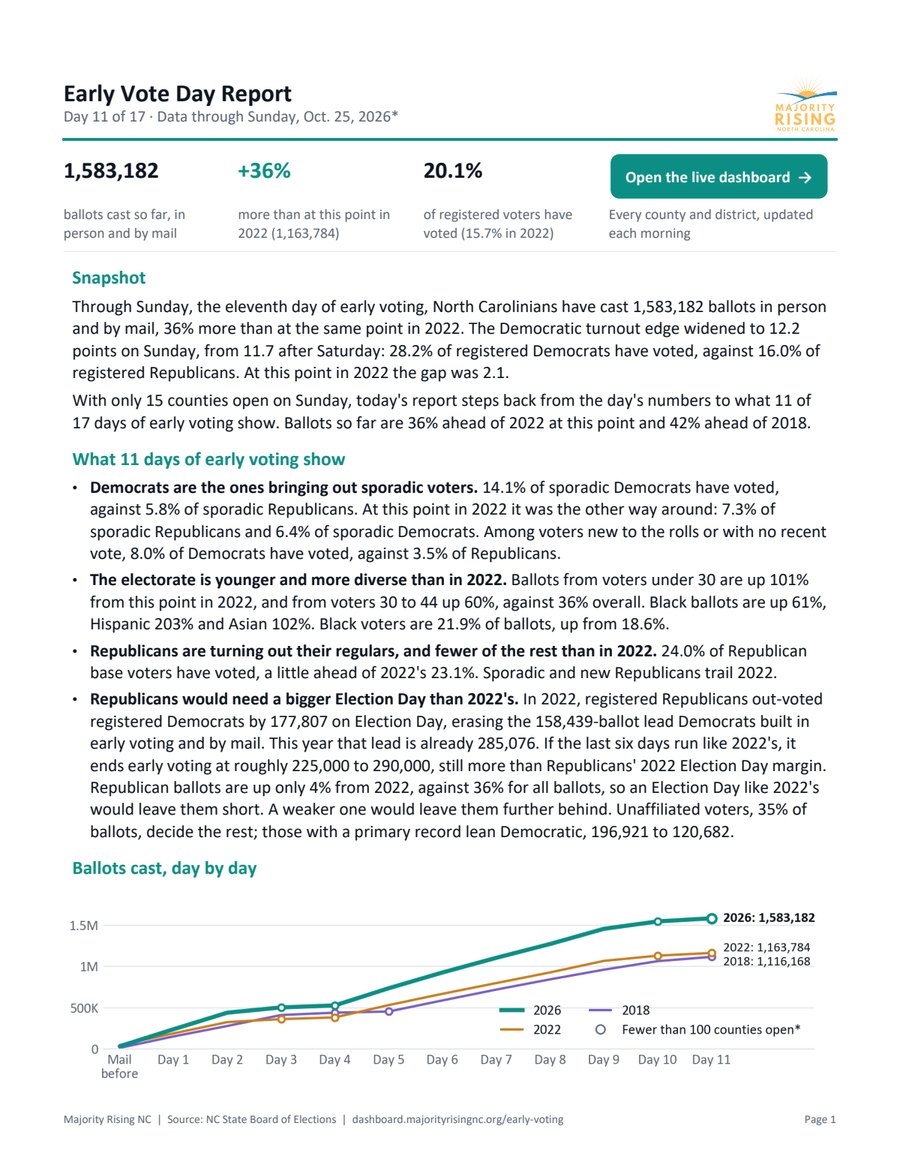
Through Sunday, the eleventh day of early voting, North Carolinians have cast 1,583,182 ballots in person and by mail, 36% more than at the same point in 2022. The Democratic turnout edge widened to 12.2 points on Sunday, from 11.7 after Saturday: 28.2% of registered Democrats have voted, against 16.0% of registered Republicans. At this point in 2022 the gap was 2.1. With only 15 counties open on Sunday, today's report steps back from the day's numbers to what 11 of 17 days of early voting show. Ballots so far are 36% ahead of 2022 at this point and 42% ahead of 2018.
What 11 days of early voting show
- Democrats are the ones bringing out sporadic voters. 14.1% of sporadic Democrats have voted, against 5.8% of sporadic Republicans. At this point in 2022 it was the other way around: 7.3% of sporadic Republicans and 6.4% of sporadic Democrats. Among voters new to the rolls or with no recent vote, 8.0% of Democrats have voted, against 3.5% of Republicans.
- The electorate is younger and more diverse than in 2022. Ballots from voters under 30 are up 101% from this point in 2022, and from voters 30 to 44 up 60%, against 36% overall. Black ballots are up 61%, Hispanic 203% and Asian 102%. Black voters are 21.9% of ballots, up from 18.6%.
- Republicans are turning out their regulars, and fewer of the rest than in 2022. 24.0% of Republican base voters have voted, a little ahead of 2022's 23.1%. Sporadic and new Republicans trail 2022.
- Republicans would need a bigger Election Day than 2022's. In 2022, registered Republicans out-voted registered Democrats by 177,807 on Election Day, erasing the 158,439-ballot lead Democrats built in early voting and by mail. This year that lead is already 285,076. If the last six days run like 2022's, it ends early voting at roughly 225,000 to 290,000, still more than Republicans' 2022 Election Day margin. Republican ballots are up only 4% from 2022, against 36% for all ballots, so an Election Day like 2022's would leave them short. A weaker one would leave them further behind. Unaffiliated voters, 35% of ballots, decide the rest; those with a primary record lean Democratic, 196,921 to 120,682.